The Architects of Impact: How Southeast Asian Fight Choreographers Are Rewriting Hollywood's Action Language
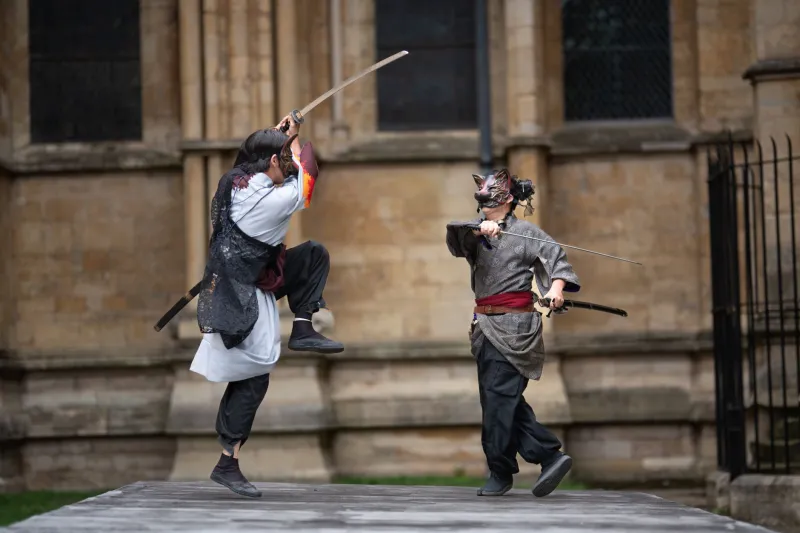
You're two hours deep into a blockbuster. The hero squares off against a hallway full of bad guys. The camera moves like it's breathing. Every punch lands with a weight that feels almost personal. You think to yourself — how did they make that feel so real?
Chances are, the answer starts somewhere in Southeast Asia.
We've talked a lot about stunt coordinators, VFX houses, and the invisible labor behind Hollywood's biggest productions. But there's a specific creative role that rarely gets discussed outside industry circles — the fight choreographer. Not the person managing safety on set. Not the one organizing the stunt team's insurance paperwork. The person who designs the violence. Who decides that a knee strike lands at this angle, that a blade parries at that height, that a fighter retreats with this particular rhythm before exploding forward.
And increasingly, that person learned their craft in a gym in Bangkok, a training hall in Ho Chi Minh City, or a studio in Manila.
Movement as Language
Here's something most audiences don't think about: every fighting style has a grammar. Muay thai has a particular cadence — patient, economical, built around controlling distance and waiting for the right moment to collapse it violently. Arnis, the Filipino martial art, treats weapons as extensions of the hand, so fighters move with a fluidity that makes armed combat look almost like dance. Vietnamese võ cổ truyền is rooted in deception — feints, misdirection, attacks that arrive from unexpected angles.
When a choreographer trained in these systems steps onto a Hollywood set, they're not just bringing physical technique. They're bringing a whole philosophy of how bodies move through conflict.
That's what makes their contribution so distinct — and so hard to replace with a generic Western action template.
"American action for a long time was very linear," one Bangkok-based choreographer explained in an industry podcast last year, speaking about the general evolution of fight design. "Two guys face each other. Punch, block, punch, block. Southeast Asian martial arts think in circles. You're always repositioning, always using the opponent's momentum. That changes everything about how a fight looks on camera."
The Credit Gap
Here's where things get uncomfortable.
The fight choreographers doing this work — the ones flying in from Southeast Asia, or who've relocated to LA while maintaining deep roots in their home training systems — frequently operate without the recognition their Western counterparts receive. In Hollywood's credit hierarchy, a fight choreographer might be buried under "additional choreography" or absorbed entirely into a stunt coordinator's credit. Sometimes their work gets attributed to a more recognizable name further up the call sheet.
This isn't unique to Southeast Asian workers, but the pattern is particularly visible here. When a production wants that "authentic" muay thai energy or that "real" Filipino knife-fighting feel, they'll hire someone with genuine roots in those traditions. Then the promotional materials will describe the fight style in general terms, crediting the lead stunt coordinator, and the person who actually designed the grammar of the combat fades into the background.
It's a quiet erasure that the industry is only beginning to reckon with.
What Muay Thai Footwork Actually Does to a Fight Scene
Let's get specific for a second, because the technical details matter.
Muay thai fighters are trained to manage what coaches call "the pocket" — that close-range zone where elbows and knees become the dominant weapons. The footwork isn't flashy. It's not the spinning, leaping choreography you might associate with wushu or capoeira. It's deliberate. Measured. It makes fighters look like they're thinking, not just reacting.
When a choreographer applies that philosophy to a film fight, the result feels different from the average Hollywood brawl. Characters don't just trade blows — they problem-solve in real time. The hero takes a hit and adjusts. An attacker's momentum gets used against them. The fight has a logic that audiences feel even if they can't articulate it.
Compare that to the mid-2000s Hollywood template — lots of spinning kicks, dramatic pauses, hits that somehow don't affect anyone's balance — and you start to understand why audiences have responded so strongly to action films that incorporate Southeast Asian martial traditions.
Wushu, meanwhile, brings something different: flow. The Chinese martial art, which has deep roots in Southeast Asian Chinese diaspora communities and is widely practiced in Vietnam, Malaysia, and across the region, prioritizes visual continuity. Movements chain together in ways that feel inevitable. For a camera, it's a gift — wushu-trained choreographers think in sequences, not individual moments, which means they're already considering how a fight will edit before a single frame is shot.
Manila's Secret Weapon: Arnis and the Art of Weapon Logic
Filipino martial arts — arnis, eskrima, kali, depending on who you're talking to and which island they're from — have been quietly influential in Hollywood for longer than most people realize. Several high-profile action franchises have incorporated arnis footwork and weapon handling into their fight design, often without naming it.
What makes arnis particularly valuable on screen is the principle of defanging the snake — disarming an opponent by targeting their weapon hand rather than going for knockout blows. It creates a kind of tactical chess that reads as intelligent on camera. The hero isn't just fighting; they're dismantling their opponent's ability to fight back. That's a narrative, not just a physical exchange.
Choreographers from Manila who work in this tradition bring that storytelling instinct to every fight they design. The combat has a beginning, middle, and end — a dramatic arc built into the movement itself.
The New Generation Is Done Being Invisible
Something is shifting, though. Slowly, but visibly.
Younger Southeast Asian fight choreographers are pushing back against the credit gap. Some are negotiating more aggressively for proper attribution before they sign contracts. Others are building their profiles on social media, documenting their process and making it harder for productions to obscure their contributions. A few have started working with independent filmmakers specifically to establish a visible track record before taking on larger studio projects.
There's also a growing appetite from US audiences for action that feels different — that has the kinetic intelligence of films coming out of Southeast Asia's own growing film industries. That appetite creates leverage.
"People have seen enough generic action," one choreographer based between Ho Chi Minh City and Los Angeles noted in an interview with an Asian film industry publication. "They want something that feels like it was designed by someone who actually trained. And that's us. We just need to make sure everyone knows it."
Why This Matters Beyond the Credits
At the end of the day, this isn't just an industry fairness argument — though it absolutely is that too.
It's about understanding where the culture you consume actually comes from. When you feel that electric, intelligent energy in a fight scene, when a brawl makes you lean forward instead of zone out, there's a good chance a Southeast Asian martial artist designed every beat of it. They brought centuries of combat philosophy to a Hollywood soundstage and translated it into something that hits you in the gut.
That deserves to be part of the story.
Next time you're watching a fight scene that feels genuinely alive, maybe ask yourself who built it. There's a good chance the answer starts with someone whose name you've never heard — and whose training began somewhere far from Hollywood.