WhatsApp, Wads of Cash, and Waybills: How Bangkok and Saigon Are Running the Global Sneaker Game from the Shadows
If you've ever copped a pair of Jordans or Yeezys through a plug rather than a platform, there's a decent chance the supply chain behind that transaction touched Southeast Asia before it touched your doorstep. Not the factory floor — that's old news. We're talking about the resale layer. The arbitrage. The hustle that happens after the shoes leave Nike's logistics centers and before they land on American feet.
America's sneaker culture loves its own mythology. We celebrate the Chicago kid who camped outside Foot Locker. We follow the LA reseller who turned a $500 investment into a six-figure operation. We download authentication apps and debate deadstock condition on Reddit threads. But while all that noise is happening stateside, a parallel economy — one that's estimated to move north of $500 million annually — is being orchestrated out of group chats, back-room boutiques, and airport cargo bays across Southeast Asia.
And the people running it? They're not looking for a profile in Sole Collector.
The Geography of the Hustle
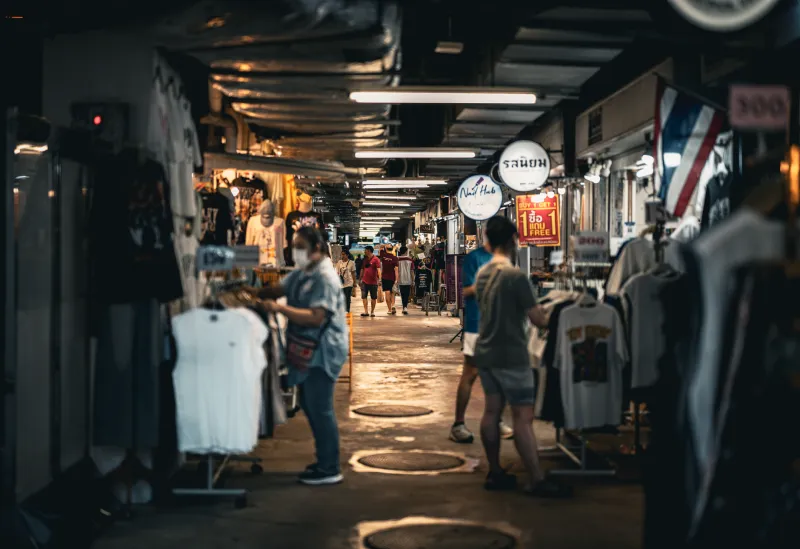
Bangkok's Chatuchak Market and the labyrinthine stalls of MBK Center are the parts of Thailand's sneaker scene that tourists photograph. But the real action is several layers deeper — operating through curated WhatsApp groups where membership is by referral only and prices shift by the hour based on exchange rates and regional release windows.
Ho Chi Minh City has its own infrastructure. Sneaker Street, a stretch of shops in District 1, is the visible tip. Underneath it is a network of dealers who've spent years building relationships with buyers in the US, Europe, and the Gulf states, offering pairs that simply aren't available through conventional resale platforms at the prices they can offer.
Jakarta rounds out the triumvirate. Indonesia's capital has produced some of the most sophisticated sneaker arbitrageurs in the game — people who treat limited releases the way day traders treat options, moving fast on information asymmetry and hedging across multiple colorways simultaneously.
What these three cities share is geography-as-advantage. Their proximity to manufacturing hubs, their access to regional Nike and Adidas distribution networks, and their ability to source from markets that American resellers simply don't monitor closely enough gives them a structural edge that no app can replicate.
The Mechanics of the Operation
Here's how it typically works, according to a Bangkok-based dealer who asked to be identified only as "P" and has been in the game for nearly a decade.
When a major release drops — say, a Jordan 1 collab or a New Balance collaboration — P's network activates across multiple time zones simultaneously. Buyers in Japan, South Korea, and Australia are hitting their local raffles. Contacts in Europe are queuing on SNKRS. Meanwhile, P is coordinating the intake, setting prices in real time, and arranging consolidation shipping through a freight forwarder he's worked with for years.
"American resellers think they're the center of the market," P told us over a video call, his camera conspicuously angled away from anything identifiable. "But they're mostly buying from us. They just don't know it."
The logistics are genuinely impressive. Shoes flow through informal but highly reliable networks — often via personal shoppers who carry pairs as luggage on regional flights, avoiding the paper trail that formal import channels would create. Larger volumes move through freight forwarders who specialize in "gray market" goods, using legal shipping methods but structuring shipments to minimize customs scrutiny.
Payment happens through a mix of channels: direct bank transfers, crypto, and in some cases, the informal hawala-adjacent systems that have facilitated value transfer across Southeast Asia for generations long before Venmo existed.
Why American Platforms Can't Touch This
StockX and GOAT have authentication labs. They have teams of experts examining stitching and box labels and QR codes. What they don't have is meaningful visibility into where their inventory is actually sourced before it arrives at their facilities.
The Southeast Asian resale network operates several steps upstream from the authentication layer. By the time a pair of shoes reaches a US-based seller who lists it on a mainstream platform, it may have passed through two or three sets of hands across Bangkok, Singapore, and Los Angeles without a single party doing anything technically illegal.
This opacity is the point. "We don't need to be on any platform," says a Ho Chi Minh City-based dealer who goes by a nickname that translates loosely to "the accountant." "Our customers come to us. They trust us more than they trust any app."
That trust is built over years of relationship maintenance — the kind of social capital that American sneaker culture, with its obsession with transaction-based platforms, has largely abandoned in favor of algorithmic verification.
The American Buyer's Blind Spot
Here's the uncomfortable truth for American sneakerheads: the democratization narrative around limited releases is largely fiction. The idea that raffles and apps level the playing field ignores the reality that sophisticated networks — especially those operating out of Southeast Asia — have already solved the access problem through sheer organizational superiority.
When a Travis Scott collab drops and you don't get a pair through the Nike app, somebody did. A chunk of those pairs flow almost immediately into WhatsApp groups in Bangkok and Jakarta, priced in Thai baht and Indonesian rupiah, and are on their way to American buyers before most US resellers have even refreshed their StockX listings.
None of this is secret, exactly. It's more that American sneaker media has never been particularly curious about supply chains that don't center American protagonists.
The Culture Behind the Commerce
What's easy to miss in all the logistics talk is that this isn't just arbitrage for arbitrage's sake. Southeast Asian sneaker culture is genuinely deep — Bangkok has produced collectors and tastemakers whose knowledge of rare colorways and production histories rivals anyone in New York or Chicago. Ho Chi Minh City's youth sneaker scene is one of the most vibrant in Asia. These aren't people who stumbled into resale as a side hustle. Many of them are lifelong sneakerheads who found a way to monetize their expertise at a global scale.
That's a story American sneaker culture hasn't told, mostly because it complicates the homegrown-hero narrative. But it's the actual story of how the market works in 2024.
What Comes Next
Authentication technology is getting better. Customs enforcement in various countries is paying more attention to high-value footwear. Platforms are trying to build more direct relationships with regional markets. All of this creates pressure on the informal networks that have thrived in the gaps.
But the dealers in Bangkok and Saigon and Jakarta aren't particularly worried. They've been operating in environments of regulatory uncertainty and economic volatility for years. Adaptability is the core competency.
"They'll build a new app," P said, almost amused. "We'll find the new gap. That's how this always goes."
He's probably right. The American sneaker market will keep obsessing over the platforms it can see. And the real game will keep running, quietly, through the group chats it can't.